
For many people, the hardest part of considering a home lift isn’t the technology — it’s recognising when stairs have become a genuine barrier rather than an inconvenience. Reaching that point can feel like a significant step, whether you’re thinking about your own mobility or supporting someone you care for.
Home lifts (often called through-floor lifts) offer a way to move safely between floors without relying on stairs at all. They can provide long-term reassurance for people whose mobility needs are changing, or for those looking to future-proof their home for the years ahead, but they are not always the simplest or most appropriate solution in every situation.
This page explores what home lifts are, how they work in practical terms, and when other options — such as stairlifts, hoists and transfer aids, or reorganising living space to avoid stairs — may be worth considering first.
Everything here is explained at a calm, independent pace, so you can understand the basics in your own time and feel informed and in control before speaking to suppliers or professionals.
What is a home lift?
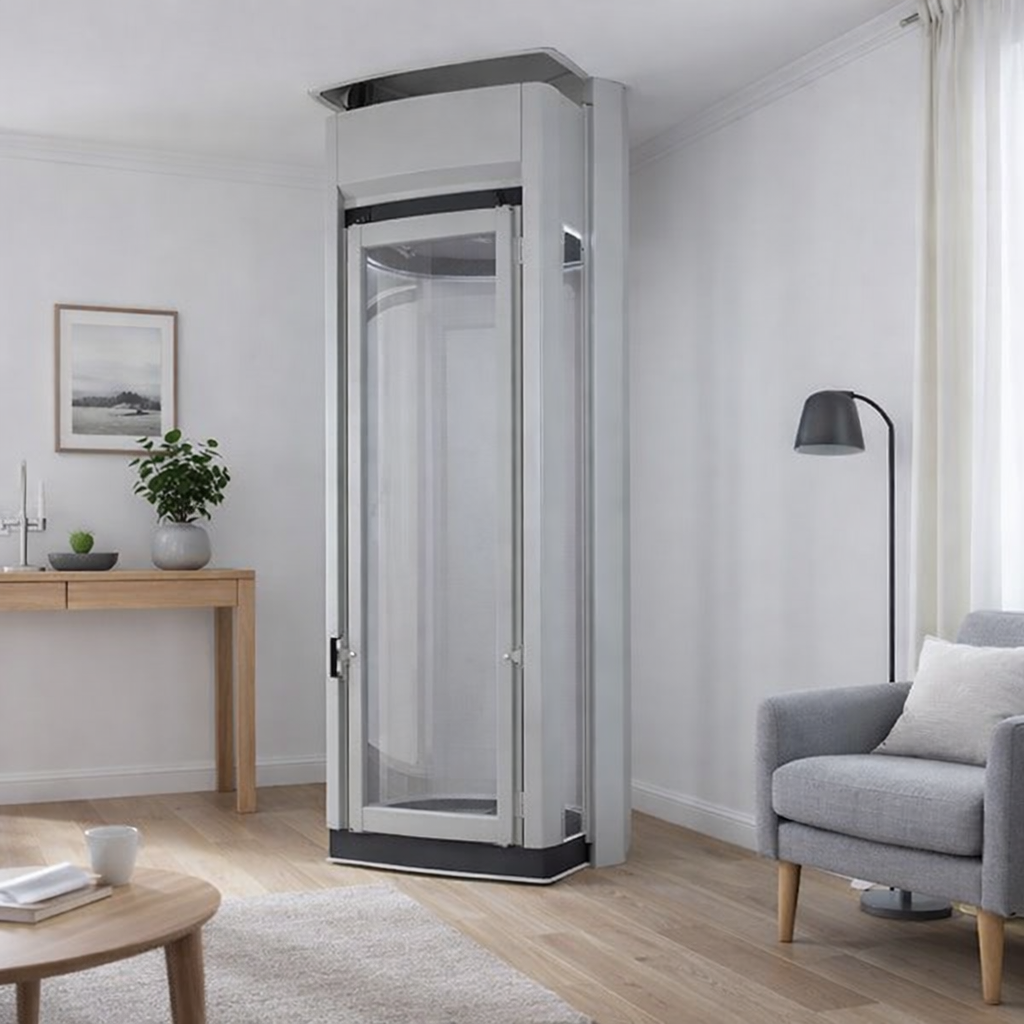
A home lift (sometimes called a domestic lift or homelift) is a compact lift designed for private houses. Unlike a stairlift, which follows the line of the stairs, a home lift moves a person — and often a wheelchair — vertically between floors.
Most home lifts either:
- travel through a cut-out in the floor and ceiling (commonly known as through-floor lifts), or
- move within a small enclosed structure or shaft, depending on the design.
A home lift may be worth considering when:
- stairs are no longer a safe or realistic way to move between floors
- wheelchair access between floors is needed
- sitting down on or standing up from a stairlift chair has become difficult or painful
- you want a more “future-proof” solution if mobility is likely to decline further
While home lifts can be life-changing adaptations, they are not the right choice for every home, situation, or budget.
⚙️ How home lifts work (in simple terms)
Modern home lifts are designed to be steady, predictable, and highly safety-focused. Although the internal drive systems vary, the everyday experience is usually straightforward:
- Entry: You enter the lift — standing, seated, or in a wheelchair, depending on the model.
- Movement: You press and hold a control or press a button. The lift travels slowly and smoothly to the next floor.
- Safety: Sensors and interlocks prevent the lift from moving if doors are open or something is obstructing its path.
Most home lifts include a battery backup or emergency lowering system. This means that if there is a power cut while the lift is in use, it can be safely lowered rather than leaving someone stuck between floors.
For through-floor lifts, the floor opening is carefully protected. When the lift is downstairs, the covered aperture above is designed to be strong and secure, and it is safe to walk over.
Types of home lifts commonly used in the UK
Although terminology varies between suppliers, most home lifts fall into a small number of practical categories. In reality, the best option is usually driven by your home layout and access needs, rather than the mechanism itself.
Through-floor lifts
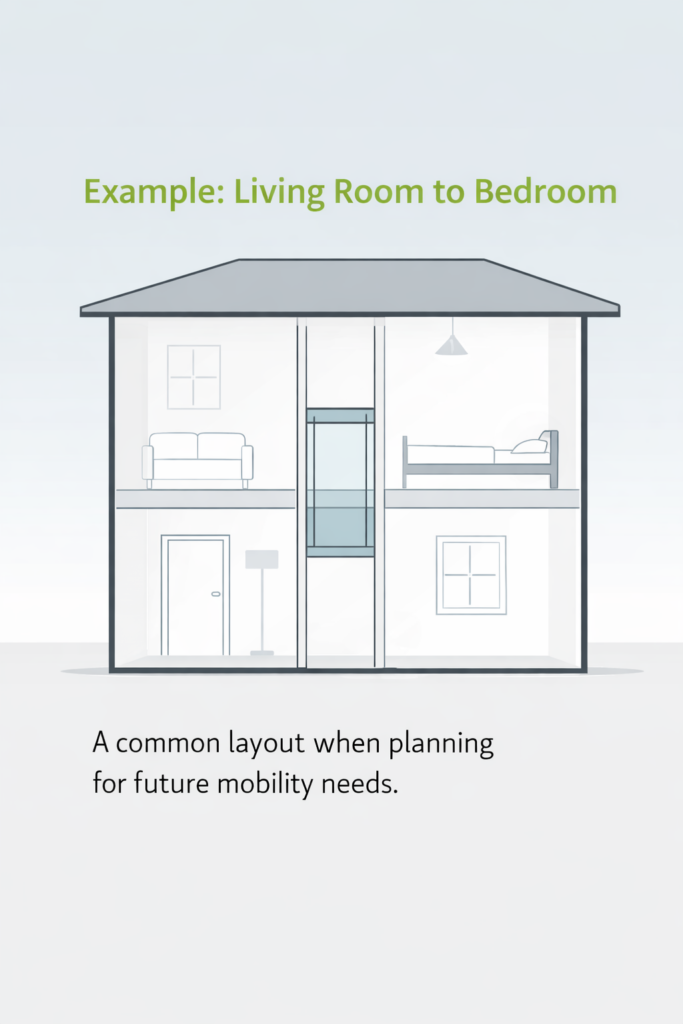
These are among the most common home lifts used as mobility adaptations.
- Travel through a neat cut-out in the ceiling and floor
- Often designed to accommodate a wheelchair and sometimes a carer
- Usually do not require a full lift shaft
- When the lift is parked upstairs, the floor opening below is securely covered, allowing the ground floor room to be used normally
This helps preserve the feel and usability of the room when the lift is not in use.
Cabin-style domestic lifts
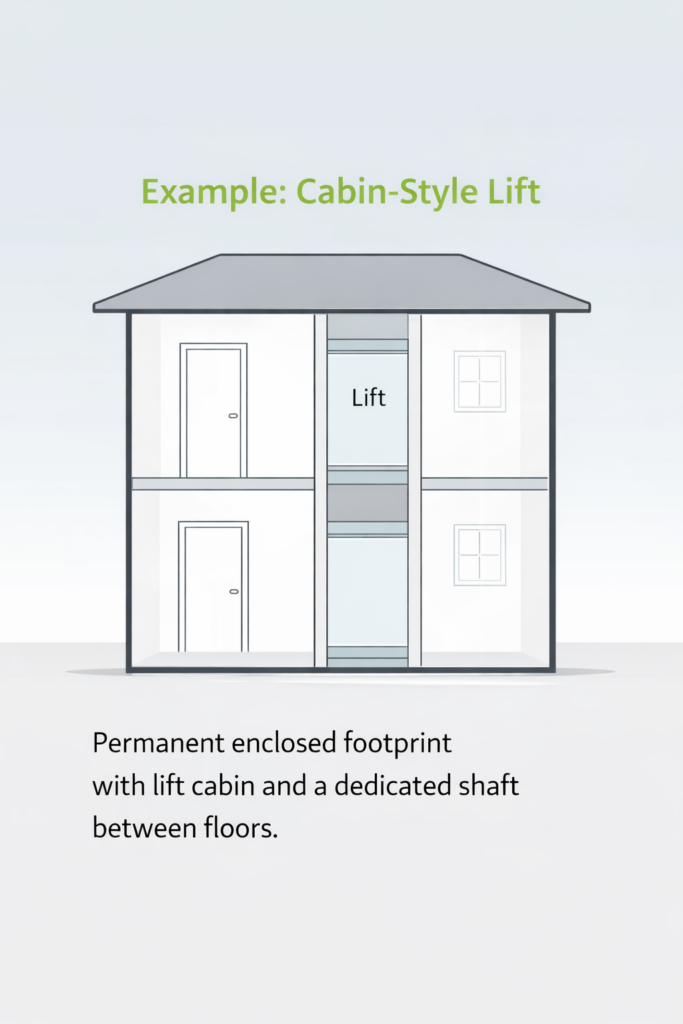
These are enclosed lifts that feel closer to a traditional small-elevator experience.
- Fully enclosed cabin, which some users find more reassuring
- Greater choice of finishes and appearance
- Usually require a permanent structure or shaft-like enclosure
- Take up a fixed footprint on both floors
External home lifts
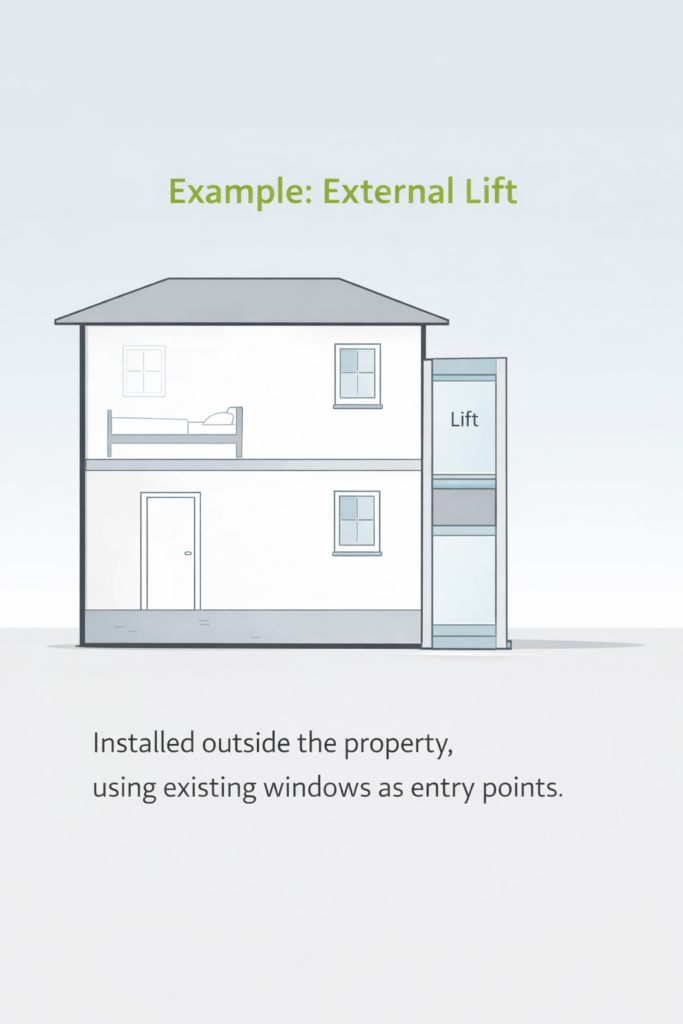
In some homes, particularly where internal space is limited, a home lift can be installed outside the property rather than within it.
This is often done by:
- replacing an existing window with a doorway on each floor, or
- creating a new opening in the external wall
The lift then runs in an external enclosure or shaft, allowing access between floors without taking up internal living space.
External home lifts are sometimes chosen when:
- internal layouts are tight or awkward
- preserving room layouts is a priority
- wheelchair access between floors is being planned in advance
They can be a practical long-term solution, but they usually involve more building work and may require planning permission, particularly if visible from the street.
Platform lifts
Platform lifts are often used for shorter vertical changes, such as:
- split-level floors
- raised entrances
- limited height changes where a ramp would be impractical
In some situations, they may also be used internally where space allows, though they are not always suitable for full floor-to-floor access in standard homes.
Who are home lifts suitable for?
Home lifts are often suitable for people who:
- experience significant pain, fatigue, breathlessness, or balance problems on stairs
- use a wheelchair for most of their daily movement
- struggle with transfers, such as sitting down or standing up safely
- have a condition where mobility is expected to change over time
- want to keep their staircase completely clear for others in the household
They are particularly relevant when wheelchair access between floors is needed, which a stairlift cannot provide.
⚠️ When a home lift might not be the most practical path forward
Despite their benefits, a home lift is not always the best option.
A home lift may not be the most practical solution if:
- the person cannot safely enter or exit the lift, even with assistance
- the home layout makes installation unrealistic without major structural changes
- the level of building work would cause unacceptable disruption
- the available space would block essential walkways or exits
- care needs are the primary concern rather than independent movement
If budget is the primary concern, it may be worth exploring whether a combination of smaller adaptations could achieve the same goal.
Key considerations before choosing a home lift
1) What problem are you actually solving?
It helps to be clear whether the main issue is:
- stairs themselves
- unsafe or painful transfers
- wheelchair access between floors
- planning for future decline rather than current difficulty
Being clear about this early makes later decisions far easier.
2) Finding the right “slot” in the house
Most home lifts succeed or fail based on where they can realistically go.
In many UK homes, common routes include:
- a corner of a living room rising into a bedroom
- a hallway rising into a landing
- a dining room rising into a spare room
It’s important to think about what the lift will arrive next to on each floor — doors, wardrobes, windows, and everyday walking routes all matter.
In many UK hallways or lounges, the most obvious location for a lift is already occupied by a radiator or storage heater. Identifying this early is helpful, as relocating heating is a common part of preparation.
If you’re unsure whether your layout would realistically allow installation, our guide on Can You Have a Home Lift in Your House? looks in more detail at space requirements, ceiling height, and structural considerations in typical UK homes.
3) The user’s day-to-day movement
Consider:
- whether the lift will be used independently or with help
- whether a wheelchair needs to fit comfortably
- how easy it is to approach and exit the lift on both floors
- whether seated, standing, or wheelchair travel is required
4) Noise, speed, and “feel”
Different lift systems can feel slightly different in use. Some people are more sensitive to sound or vibration than others. If possible, visiting a showroom or Disabled Living Centre can help set expectations.
5) Building work and disruption
Even lifts described as “quick to install” usually involve:
- structural work to floors and ceilings
- electrical work
- making good plasterwork and flooring
It’s worth understanding early on what work is included in a quote, and what may be additional.
Advantages and disadvantages of home lifts
Advantages
- Allow wheelchair-friendly access between floors
- Remove reliance on stairs entirely
- Often more suitable for long-term or progressing mobility needs
- Can help people remain in their own homes
Disadvantages
- Higher cost than stairlifts or simpler adaptations
- Require building work and loss of some floor space
- Not suitable in all layouts
- Ongoing servicing and maintenance should be expected
Understanding the practicalities is one step; the next is usually considering the financial commitment involved.
💷 Typical home lift costs in the UK (general guidance)
Home lift costs vary widely depending on type, size, and installation complexity.
As a general guide:
- Through-floor lifts: often around £19,000 to £29,000
- Cabin-style domestic lifts: commonly £25,000 to £35,000 or more
Building work, electrical changes, and finishing can add to these figures, particularly in older or more complex properties.
Financial support: Disabled Facilities Grant
In some cases, financial help may be available through a Disabled Facilities Grant (DFG), subject to assessment and eligibility.
Typical maximum amounts include:
- England: up to £30,000
- Wales: up to £36,000
- Northern Ireland: up to £25,000
It’s worth noting that Disabled Facilities Grants are means-tested, so the level of support varies between households. (Scotland uses different routes for funding home adaptations.)
When alternatives may be more appropriate
A home lift is a significant step. Before committing, it can help to consider whether simpler options might meet the real need.
These can include:
- stairlifts, if seated travel and transfers are still safe
- reorganising the home so essential living happens on one floor
- adapting a downstairs room into a bedroom
- hoists, where full physical assistance is required
A home lift is one possible solution — not the default solution.
Organisations such as Age UK also provide practical, independent guidance on adapting homes as mobility needs change, including information on lifts, grants, and alternative adaptations.
Questions to consider before speaking to suppliers
Before requesting quotes, it can help to reflect on:
- who will use the lift now, and whether that may change
- whether wheelchair access is needed now or likely in future
- whether a carer may need to travel with the user
- whether the lift has enough space for two people, if support may be required later
- where the lift will be parked most of the time
- how it will affect light, space, and movement in each room
- what servicing is required, and what it costs
Final thoughts
A home lift is a significant commitment, both financially and in terms of changes to the home itself. For many people, however, that investment is balanced by the ability to move between floors safely and confidently again.
Taking an unhurried approach helps. By thinking about how movement works today — and how it may change over time — it becomes easier to choose a solution that remains practical and reassuring in the years ahead.
This guide is intended to give you a clear foundation, so any next steps are thoughtful, realistic, and taken at your own pace.
If you’d like to explore this topic further, you may find it helpful to visit our home lifts guidance hub, which brings together related articles on stairlift types, alternatives, and planning considerations.