
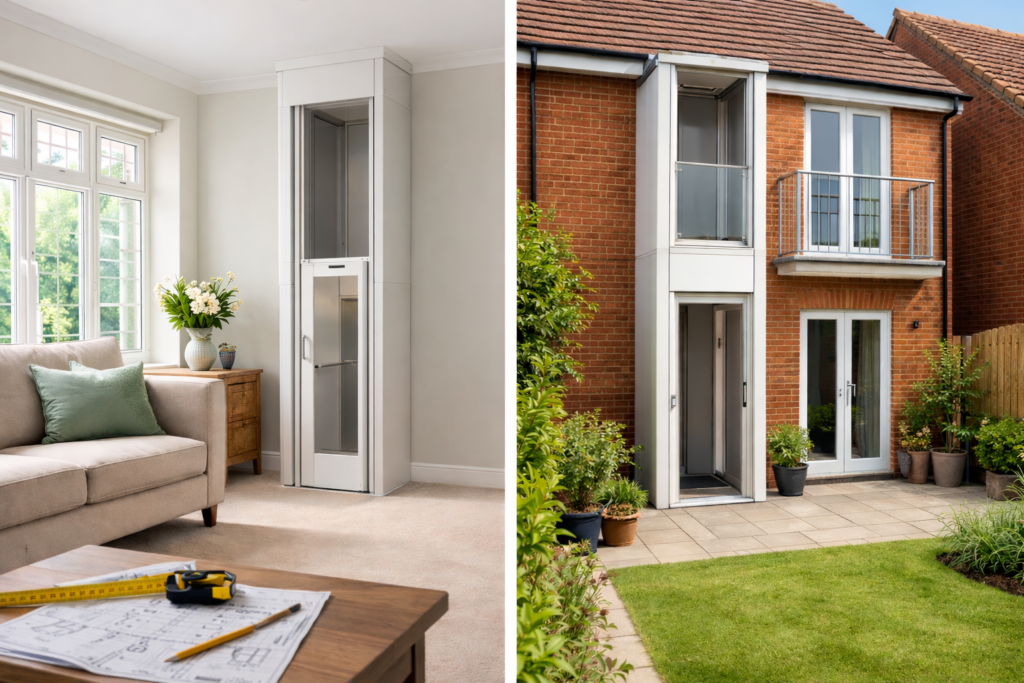
Most people don’t start by asking what a home lift is. The more practical question is this: can you have a home lift in your house?
Behind that simple question sit a few real concerns — space, disruption, cost, and whether your property is structurally suitable.
The idea of cutting a hole in your floor can feel daunting. It sounds disruptive, permanent, and expensive. In reality, for many standard UK homes, the structural work is a routine process that usually involves a few days of concentrated (and admittedly dusty) preparation before the lift itself is installed.
The key thing to understand is this:
Suitability depends less on the age of your home and more on its layout.
Many terraced, semi-detached, and detached properties can accommodate a home lift. Others cannot — not because they are “unsuitable houses,” but because space, structure, or ownership restrictions make installation unrealistic.
Understanding what makes a home lift possible helps you avoid unnecessary stress before contacting suppliers.
If you’d like a broader overview of how home lifts work, typical costs, and when they’re most appropriate, you can start with the HomeFreedom Guide to Home Lifts, before returning here to assess whether one could work in your property.
📏 Do Most UK Homes Have Enough Space?
In many cases, yes — but space must exist in the right place.
Most internal through-floor lifts require a footprint of roughly 1 square metre or slightly more on both floors.
Rather than thinking in measurements, picture it this way:
- About the size of a large armchair
- Or a small downstairs cloakroom
- Or the space taken up by a tall storage cabinet
That space becomes permanently occupied in both your downstairs room and the room above.
Typical UK installations often run:
- From a living room corner into a bedroom
- From a hallway into a landing
- From a dining room into a spare room
Very small terraces or tightly arranged layouts can be more challenging — not because they are old, but because there may not be a clear vertical “slot” between usable spaces.
Don’t Forget the Hidden Layout Issues
In many UK homes, the most convenient corner is already occupied by:
- A radiator
- Boxed-in pipework
- Electrical sockets
- A consumer unit (fuse box)
Relocating these isn’t unusual, but it does add preparation work and sometimes additional cost. It’s worth noticing these early.
What If There Isn’t Enough Internal Space?
If internal space is too limited, an external home lift may sometimes be an option.
Instead of travelling through the floor, the lift is installed against the outside wall of the property. Access is created by forming door openings on each floor, often replacing existing windows.
This can:
- Preserve internal room layouts
- Avoid losing valuable floor space
- Provide a clear vertical route where none exists internally
While it sounds like a major alteration, external lifts can often be finished in materials that match brickwork or cladding, helping them feel like a considered extension rather than an industrial add-on.
However, they usually involve:
- More building work
- Higher costs
- Planning considerations if visible from the street
🏠 Will a Home Lift Work in a House With Low Ceilings?
Home lifts require sufficient headroom to operate safely.
In most standard UK homes — where ceiling heights are typically around 2.3 to 2.4 metres — installation is usually possible without issue.
As a general guide, many through-floor lifts require around 2.2 metres or more of clear floor-to-ceiling height. Some compact models may work in slightly lower spaces, but very low ceilings can restrict options.
Challenges may arise if:
- The ground floor ceiling is unusually low
- A loft conversion has reduced head height upstairs
- The lift would arrive beneath a sloping ceiling
- There are bulkheads or boxed-in structural beams
If ceilings feel noticeably low, measuring from finished floor to finished ceiling early on can prevent disappointment later.
Where headroom is borderline, suppliers can usually confirm feasibility during an assessment visit.
🧱 Does the Floor Need to Be Strengthened?
Yes — but that doesn’t automatically mean major reconstruction.
A structural opening is created in the floor and ceiling, and the surrounding floor must be reinforced to maintain safety.
In many timber-floored homes, this is a standard procedure. Concrete floors or unusual structures may require more specialist preparation.
The phrase “cutting through the floor” can sound alarming. In practice, installers work within structural guidelines and Building Regulations, and the process is usually contained within a defined area.
Can you have a Home Lift in a Terraced or Semi-Detached House?
Often, yes.
Terraced and semi-detached homes are among the most common properties adapted with through-floor lifts.
What matters most is:
- Whether rooms align vertically
- Whether there is enough clearance upstairs and downstairs
- Whether installation would block essential doorways or exits
Detached properties may offer more flexibility, but layout matters more than overall house size.
Can I Install a Home Lift in a Leasehold Flat?
Flats are generally more complex than houses.
In most standard single-level flats, a home lift is not relevant because there is no internal staircase to replace.
However, if you live in a split-level flat or maisonette (where your own property is arranged over two floors), installation may be technically possible — but additional permissions are usually required.
The main challenges in flats are not always structural — they are legal.
You may need:
- Freeholder consent
- Management company approval
- Compliance with lease terms
- Building Regulations approval
If the lift affects shared structure, communal areas, or the external appearance of the building, permission becomes even more important.
External lifts in blocks of flats are sometimes proposed, but these almost always require formal approvals and may not be permitted.
For leasehold properties, legal feasibility can be just as significant as physical space.
⚖️ Internal vs External Home Lifts — A Quick Comparison
| Feature | Internal (Through-Floor) | External (Wall-Mounted) |
|---|---|---|
| Space impact | Loses roughly ~1m² (or a little more) in two rooms | Preserves internal floor space |
| Building work | Cutting and reinforcing floors (plus making good) | Creating new door openings in external walls (plus making good) |
| Planning | Often not required (but may apply for Listed buildings / conservation areas) | More likely, especially if visible from the street |
| Visual impact | Generally discreet indoors (often looks like a tall cabinet) | Visible externally, though it can often be finished to suit the property |
| Typical cost | Often lower than external installations (depending on building work) | Often higher due to more extensive structural work |
This table isn’t about which is “better” — only which suits your home’s layout.
⚠️ Situations Where a Home Lift May Not Be Practical
A home lift may not be realistic if:
- There is no clear vertical alignment between usable rooms
- Installation would block escape routes
- Ceiling heights are insufficient
- The structural alterations required would be excessive
- Leasehold restrictions prevent changes
In some cases, reorganising the home so essential living happens on one floor, or considering a stairlift, may be more proportionate.
When a Stairlift May Be More Appropriate
If a home lift is not structurally feasible — or if the building work feels disproportionate — a stairlift may be the more practical option.
Stairlifts require significantly less alteration to the property and are often suitable in homes where cutting through floors simply isn’t realistic. They can provide safe seated travel between floors without major structural change.
The differences are usually practical rather than technical. The table below summarises how the two options compare in a typical UK home.
| Consideration | Home lift | Stairlift |
|---|---|---|
| Structural work | Requires a floor opening and building work | Minimal alteration to the staircase |
| Space impact | Takes some floor space in two rooms | Uses the existing stair route (no floor space taken) |
| Wheelchair access | Often suitable for wheelchair travel (model-dependent) | Not suitable for wheelchair users |
| Installation time | Usually several days including preparation and making good | Often installed within a day |
| Best suited for | Long-term or progressing mobility needs; avoiding stairs entirely | Seated stair travel where transfers on/off a chair are safe |
If your home cannot accommodate the structural changes required for a lift, a stairlift may provide a practical and far less disruptive alternative. Our HomeFreedom Guide to Stairlifts explains how they work and when they are most appropriate.
A Practical Tip: Check the “Landing Zone”
When assessing upstairs space, consider where the lift will arrive.
Make sure it doesn’t:
- Open directly against the side of a bed
- Block wardrobe doors
- Restrict movement around furniture
- Create a narrow passage that becomes a new mobility barrier
A lift should solve a problem — not create a different one.
A Simple Self-Check Before Requesting Quotes
Before contacting suppliers, it may help to ask:
- Do I have space roughly the size of a large armchair on both floors in the same position?
- Would losing that space disrupt daily movement?
- Are ceilings of standard height?
- Are there radiators or pipework that would need relocating?
- Is this for current need or future planning?
- Would a simpler adaptation meet the need just as effectively?
The Next Step
If your home appears structurally suitable, the next step is usually an assessment visit from a supplier or occupational therapist.
While a home lift is a significant alteration, many installations are more routine than they first appear. Taking time to understand feasibility helps ensure that any decision — whether to install a lift or explore alternatives — feels proportionate, informed, and right for your home.
If funding is a concern, the UK government explains eligibility and application details for the Disabled Facilities Grant on the official GOV.UK website.