
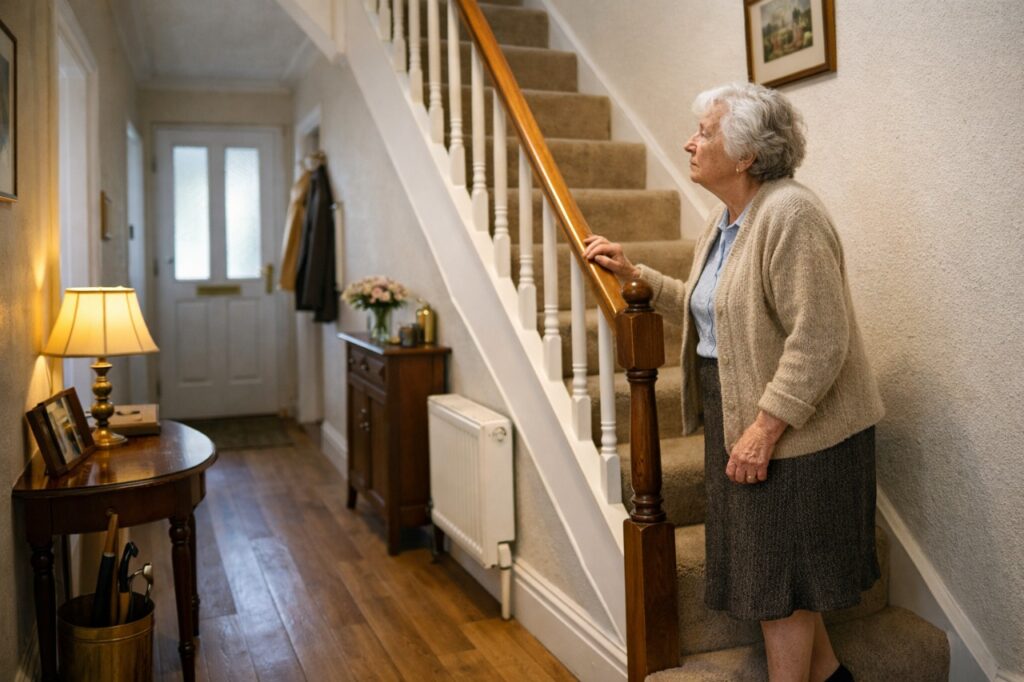
Key takeaway (short on time):
A stairlift usually works best if you can sit upright safely and your staircase has at least 650mm of usable width. If transfers are difficult, stairs are very narrow, or long-term needs are changing, a home lift or ground-floor living may be a better option.
Can you have a stairlift? This guide helps you understand whether a stairlift is likely to work well in your home, what practical and safety factors matter most, and when it may be worth exploring other options — so you can make an informed decision before speaking to an installer.
If you’re at the start of your research, this article sits within The HomeFreedom Guide to Stairlifts, which covers everything from suitability and costs to alternatives and long-term planning.
Stairlifts are often described as a simple solution to mobility problems — but in reality, they don’t suit every person or every home.
For many people, the staircase is the heart of the home. The idea of adding a rail and chair can feel like a big change to a space you’ve lived with for years. This guide explains when a stairlift usually works well, when it may not be the best option, and what alternatives are worth considering, so you can make an informed decision before speaking to an installer.
🧍♂️ When do stairlifts usually work well?
Stairlifts are most suitable when the main challenge is climbing stairs, rather than sitting, balancing, or understanding how the equipment works.
They are commonly a good option for people who:
- Struggle with knee or hip pain
- Have arthritis affecting the lower limbs
- Experience breathlessness or fatigue on stairs
- Have balance issues but can sit upright safely
- Are recovering from surgery or injury
- Have stable neurological conditions affecting strength or stamina
In these situations, a stairlift can reduce fall risk, conserve energy, and help someone remain independent in their own home.
⚠️ When might a stairlift not be the best option?
A stairlift isn’t just about the staircase — it also depends on how safely and comfortably someone can use the chair itself.
A stairlift may not be the right solution if someone:
- Cannot sit upright safely for several minutes
- Has significant trunk or core weakness
- Experiences severe involuntary movements or spasms
- Finds new equipment confusing, or may feel distressed by the movement or noise of the chair
- Cannot transfer on and off the seat reliably, even with assistance
Most modern stairlifts include a swivel seat at the top of the stairs, which turns to face the landing and reduces fall risk when standing up. Even so, safe transfers and comfort are essential, and a reputable installer will always assess this carefully.
📐 Will a stairlift fit on my stairs?
Many people assume stairlifts fit any staircase. In practice, the staircase itself is often the deciding factor.
Common practical considerations in UK homes include:
- Narrow stairs — most stairlifts need around 650mm of usable width
- Steep staircases, often found in Victorian terraces
- Winder stairs with triangular steps
- Tight landings at the top or bottom
- Radiators at the foot of the stairs
- Bulkhead cupboards or low ceilings near the bottom step
- Fixed bannisters, pipes, or doorways opening onto the stairs
Straight staircases are usually the simplest and most affordable to adapt. Curved or irregular stairs can still be suitable, but they require bespoke rails and careful surveying.
🏠 Household and day-to-day considerations
Even if a stairlift fits technically, it still needs to work for everyone who uses the home.
Things that are often overlooked:
- Shared staircases in family households
- Whether others can safely walk past the folded seat
- Fire escape routes
- Pets creating trip hazards around the rail
- Carers needing clear stair access
In smaller UK houses, these practical points can matter just as much as measurements on paper.
🏡 What about bungalows and single-storey living?
For some people, avoiding stairs altogether may be the safest long-term approach.
Single-storey living — including bungalows — can reduce fall risk and physical strain. However, moving home is a major decision, and bungalows are often:
- Harder to find
- More expensive than equivalent houses
- Emotionally difficult to move into, especially after many years in the same home
Many people choose a stairlift to remain in their current home, sometimes as a medium-term solution. Others decide that moving is better long-term. There’s no single “right” answer — it depends on health, finances, family support, and personal priorities.
🔄 When a stairlift isn’t the right solution
If a stairlift isn’t suitable, there are other ways to improve safety and accessibility at home.
These may include:
- Through-floor or home lifts
- Vertical platform lifts
- Reconfiguring living space to the ground floor
- Relocating bedrooms or bathrooms
Before making major structural changes, a free assessment from a local authority Occupational Therapist (OT) can be extremely helpful. An OT may suggest simpler aids — such as an additional bannister or a perching stool — that are enough for now.
✅ Stairlift suitability: a quick self-check
| Question | Yes / No |
|---|---|
| Can you sit upright safely for several minutes? | ⬜ |
| Can you transfer on and off a chair safely? | ⬜ |
| Are your stairs at least 650mm wide? | ⬜ |
| Is there clear space at the top and bottom landing? | ⬜ |
| Will others still be able to use the stairs safely? | ⬜ |
If several answers are “no” or “not sure”, a professional assessment is especially important.
In many cases, a free assessment from an Occupational Therapist — often accessed via the NHS or local council — can help clarify whether a stairlift is the right next step.
🔍 What does a stairlift assessment involve?
A proper stairlift survey usually includes:
- Measuring stair width, angle, and landings
- Assessing mobility and transfers
- Checking power supply and charging points
- Identifying safety considerations
- Discussing carers and household needs
Good installers will be honest if a stairlift isn’t suitable — even if that means recommending an alternative.
🧭 Final thoughts
Stairlifts can be life-changing when they’re the right solution, but they aren’t universal.
Understanding the practical considerations — personal, physical, and structural — helps you make safer, more confident decisions about adapting your home.
If you’ve established that your stairs are wide enough and you can sit safely, your next step is to explore the difference between straight and curved stairlifts or our guide to stairlift costs in the UK, both covered in The HomeFreedom Guide to Stairlifts.