
Stairlifts are one of the most common ways people manage stairs as knees, hips, or energy levels change — but they aren’t the right solution in every situation.
Understanding how stairlifts work, who they tend to suit best, and when other options may be more appropriate can make decisions feel far less pressured, especially when mobility changes gradually rather than all at once.
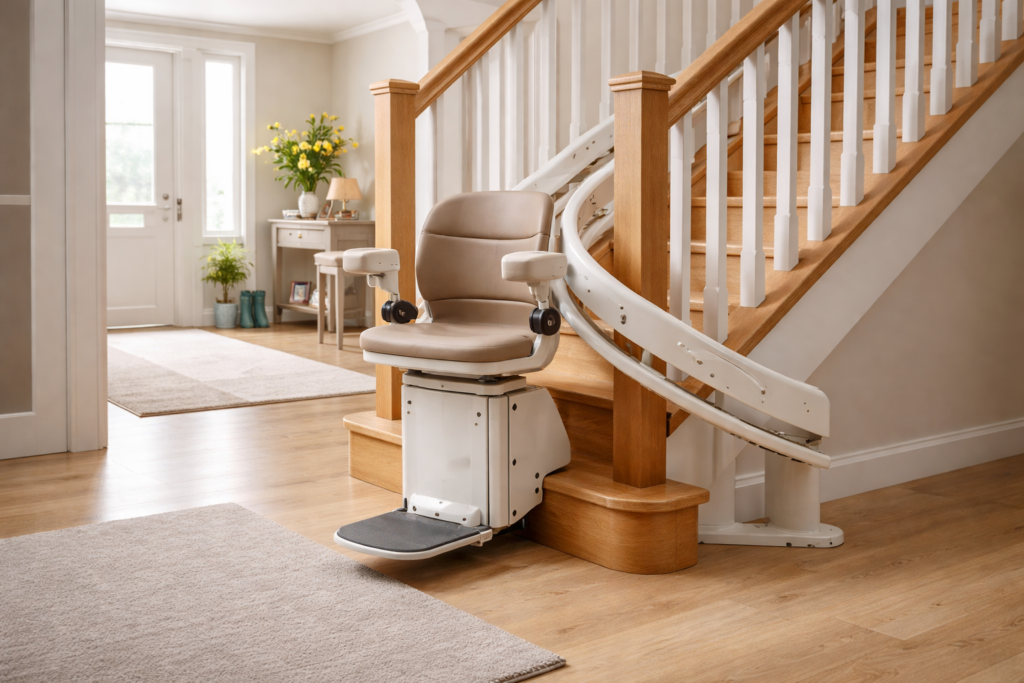
At its simplest, a stairlift is a motorised chair that travels along a rail fixed to the staircase, allowing someone to move safely between floors while remaining seated.
Thinking about stairs can feel daunting, whether for yourself or for someone you care for. This page is designed to help you understand the basics at your own pace and without pressure, so you feel more confident and informed before speaking to suppliers or professionals.
What is a stairlift?
A stairlift is a motorised chair or platform that travels along a rail, usually fixed to the staircase, though in some cases it may be mounted to a wall.
Its purpose is to provide a safe, steady way to move between floors without the physical effort or risk involved in using the stairs on foot.
Most stairlifts are powered by a rechargeable battery, which is topped up from the household electricity supply when the lift is parked.
They are operated using simple controls on the armrest and move at a slow, controlled pace, stopping at the top and bottom of the stairs.
Stairlifts are generally used to support people in a few common ways:
- Reduce the risk of falls on stairs
- Support people with reduced strength, balance, or joint mobility
- Allow continued access to upstairs rooms such as bedrooms or bathrooms
They are practical mobility aids, but they are not medical devices.
They are also not suitable for every home or every person.
Before looking at types, costs, or installation details, many people first need to answer a more basic question: can you have a stairlift at all in your home and situation.
This is explored in more detail in our guide on can you have a stairlift, which walks through the key suitability, safety, and staircase considerations before you go any further.
⚙️ How stairlifts work (in simple terms)
A stairlift is made up of a small number of parts that work together to keep movement steady and predictable.
The rail
This is the track the lift travels along. Unlike what many people expect, it is usually fixed to the stair treads themselves rather than the wall.
This often means wallpaper, plaster, and paintwork are left untouched.
The chair
This is the seat. It is designed to be sturdy but comfortable, usually with armrests, a seatbelt, and a footrest that moves with the user.
The motor and battery
Tucked beneath the seat, this powers the lift.
The battery automatically recharges whenever the stairlift is parked at the top or bottom of the stairs.
To move, the user remains seated and holds a small paddle or button on the armrest.
The moment they let go, the lift stops, which helps keep the user in control of the pace.
Most stairlifts also include features designed to improve safety and day-to-day use:
- Folding seats, armrests, and footrests to keep the stairs clearer
- Sensors that stop the lift if something is in the way
- Battery operation, so the lift can still be used during a power cut
Types of stairlifts
Because every home is built differently, there are three main types of stairlift to consider.
Straight stairlifts
Straight stairlifts are designed for staircases that go directly from one floor to another with no bends or intermediate landings.
They are:
- The simplest type of stairlift
- Usually quicker to install
- Typically the most affordable option
They are not suitable for staircases with turns or curves.
Curved stairlifts
Curved stairlifts are designed for staircases with bends, corners, or half-landings.
This is particularly common in many UK homes, such as Victorian terraces or 1930s semi-detached houses, where stairs often have a sharp “fan” or “kite” turn near the top.
With curved stairlifts:
- The rail is custom-made to follow the exact shape of the staircase
- The lift can navigate tight turns and more complex layouts
- Design and installation usually take longer
Because each rail is bespoke, curved stairlifts are usually more expensive than straight models.
Outdoor stairlifts
Outdoor stairlifts are used for steps outside the home, such as garden steps or raised entrances.
They are:
- Built from weather-resistant materials
- Designed to cope with rain, frost, and dirt
- Often supplied with a protective cover
Who are stairlifts suitable for?
Stairlifts are often suitable for people who can still walk short distances but find stairs difficult, tiring, or unsafe.
They may be appropriate for someone who:
- Can sit upright and transfer safely onto and off a chair
- Experiences pain, breathlessness, or fatigue when using stairs
- Has a stable condition affecting mobility
- Wants to continue living in a multi-storey home
For many people, a stairlift offers reassurance as well as physical support.
⚠️ When stairlifts may not be suitable
There are situations where a stairlift may not be the safest or most practical option.
A stairlift may not be suitable for:
- People who struggle to remain secure while seated
- People who need significant physical assistance to transfer
- People who rely on a wheelchair for all their movement and cannot stand or pivot
- People with cognitive difficulties that affect safe use
- Homes with very narrow or unusually steep staircases
In these cases, other forms of home adaptation may be safer or more appropriate.
Key considerations before choosing a stairlift
Before thinking about specific models, it helps to look carefully at both the home and daily routines.
The staircase
You’ll want to look at things like:
- The width and steepness of the stairs
- Any bends or landings
- Doors at the top or bottom of the staircase
In many UK homes, radiators or storage heaters are positioned near the bottom of the stairs.
These can sometimes affect where a rail or parked chair would sit, so they are worth noticing early on.
Even when folded, a stairlift takes up space.
It is important to ensure others can still use the stairs comfortably.
The user’s mobility and confidence
Think about how easy it is for the person to:
- Sit down and stand up safely
- Reach and use the controls
- Fasten and release the seatbelt
Some people find swivel seats at the top of the stairs reassuring.
Others may feel uncertain at first.
Confidence is an important part of safe day-to-day use.
Shared living space
If the home is shared, it helps to consider:
- Whether the folded lift narrows the stairs
- Carrying laundry or larger items past the lift
- How everyday movement around the house will feel
Small practical details often make the biggest difference.
Advantages and disadvantages of stairlifts
| Advantages | Disadvantages |
|---|---|
| Can reduce the risk of falls on stairs | Not suitable for all mobility needs |
| Help people continue using upstairs rooms | Can feel slow or restrictive for some users |
| Usually less disruptive than major building work | May reduce usable stair width |
| Can be removed if no longer needed | Curved models can be expensive |
Being aware of both sides helps set realistic expectations.
Organisations such as Age UK also provide practical guidance on staying safe and independent at home as needs change.
💷 Typical stairlift costs in the UK (general guidance)
As this guide to stairlifts explains, the cost of a stairlift in the UK depends mainly on the type of staircase and how the rail is made.
Prices can vary, but the ranges below give a more realistic sense of what people are commonly quoted.
Straight stairlifts
For a straight staircase with no turns:
- Typically around £2,000 to £4,000
- Usually the most affordable option
- Faster to manufacture and install
Curved stairlifts
For staircases with bends, corners, or half-landings:
- Often £4,000 to £7,000 or more
- Higher cost reflects the custom-made rail
- Common in older UK homes with tight or angled stairs
Outdoor stairlifts
For steps outside the home:
- Often similar to straight stairlifts, or higher
- Cost depends on length, exposure, and weather protection
- May be closer to curved stairlift pricing in more complex setups
In some cases, financial help may be available through local authorities, such as the Disabled Facilities Grant, depending on individual circumstances.
Common misconceptions about stairlifts
There are a few common assumptions about stairlifts that can cause unnecessary worry.
“They damage the house”
Stairlifts are usually fixed to the stairs themselves rather than structural walls, and they can be removed if no longer needed.
“They are only for very elderly people”
People of many ages use stairlifts, including those recovering from injury or living with long-term conditions.
“They work for everyone”
Stairlifts help many people, but they are not suitable for every situation or level of mobility.
“They stop working in power cuts”
Most modern stairlifts operate on batteries and can continue to work for a period without mains power.
When alternatives may be more appropriate
Depending on a person’s needs and the layout of the property, other options may be more suitable.
These can include:
- Home lifts or through-floor lifts
- Hoists for people who need full assistance
- Reorganising living spaces to avoid stairs altogether
A stairlift is one possible solution, but it is not the only one.
Questions to consider before speaking to suppliers
Before contacting anyone, it can help to reflect on a few practical points.
You might want to think about:
- Who will be using the stairlift now, and whether that may change
- Whether mobility needs are likely to progress over time
- Whether a seated lift would still be suitable if strength or balance declined further
- How confident the user feels about using equipment independently
- How the lift will affect others in the household
Thinking about future needs can be especially important for carers supporting someone with a progressive condition.
If you’d like to explore this topic further, you may find it helpful to visit our stairlifts guidance hub, which brings together related articles on stairlift types, alternatives, and planning considerations.
Final thoughts
Stairlifts can be a practical and reassuring way to manage stairs in the right circumstances.
They are not suitable for everyone, but when chosen carefully, they can help people remain comfortable and independent in their own homes.
This guide is intended to give you a clear foundation, so any next steps are informed and taken at your own pace.