
We often focus on walking when we think about mobility, but the most tiring — and risky — moments are often the in-between ones: moving from a bed to a chair, a chair to a wheelchair, or standing safely in the bathroom.
Hoists and transfer aids are designed to support people at this stage, when strength, balance, or confidence make everyday movements harder. They can reduce physical strain, improve safety, and make care routines more manageable for both individuals and the family carers supporting them — but they are not always the right solution in every situation.
For many families, introducing this kind of equipment can feel like an emotional pivot. It may signal a shift from independent movement to shared support, and that can take time to process. These decisions rarely need to be made overnight, and this page is written with that reality in mind.
The aim here is to help you understand what hoists and transfer aids are, how they’re commonly used, who they tend to suit, and when other adaptations may be more appropriate. Everything is explained at a steady, independent pace, so you feel informed and grounded before speaking to occupational therapists or equipment suppliers.
What are hoists and transfer aids?
Hoists and transfer aids are equipment designed to support or replace physical lifting during movement between positions.
They are typically used when someone:
- cannot safely stand or pivot on their own
- needs hands-on assistance from a carer
- is at risk of falling during transfers
- experiences pain, weakness, fatigue, or instability
- uses a wheelchair for most or all mobility
Unlike stairlifts or home lifts, which move someone between places, hoists and transfer aids focus on the moment of transfer itself.
They are often used:
- between bed and chair
- between chair and wheelchair
- in bathrooms and toilets
- during dressing or personal care
In many cases, they are not about “giving up independence”, but about making care safer, calmer, and sustainable — for everyone involved.
⚙️ How hoists work (in simple terms)
Although designs vary, hoists all work on the same basic principle. They take the weight of the person being moved, so transfers do not rely on strength, balance, or physical lifting.
A typical hoist system includes:
- a lifting mechanism (manual or powered)
- a sling or support that cradles the body
- a frame, track, or base that supports the lift
The person being transferred is supported by the sling, and the hoist raises and moves them slowly and steadily into a new position.
Modern slings are designed with soft, supportive fabrics. Because the sling is the only part of the system that actually touches the user, it is the most personal part of the setup. An Occupational Therapist will help select the right type and size — much like fitting shoes — so the person feels held and secure, rather than simply lifted.
Most modern hoists are electrically powered and include battery backups, so they can still be used safely during a power cut.
Movement is deliberately slow and predictable, helping the experience feel calm and reassuring rather than rushed.
Types of hoists commonly used in the UK
Mobile hoists
Mobile hoists are freestanding units on wheels.
They are:
- commonly used in bedrooms, living areas, and care settings
- flexible and not fixed to the building
- suitable for occasional or short-term use
However, they do need space to work properly.
In a typical UK bedroom, it’s important to think about the turning circle and whether the hoist’s legs can slide underneath the bed to get close enough for a safe transfer. Thick carpets, furniture placement, and narrow layouts can all affect usability.
Mobile hoists are often chosen when:
- the home cannot be structurally altered
- care needs are changing or temporary
- hoisting is required in more than one room
Ceiling track hoists
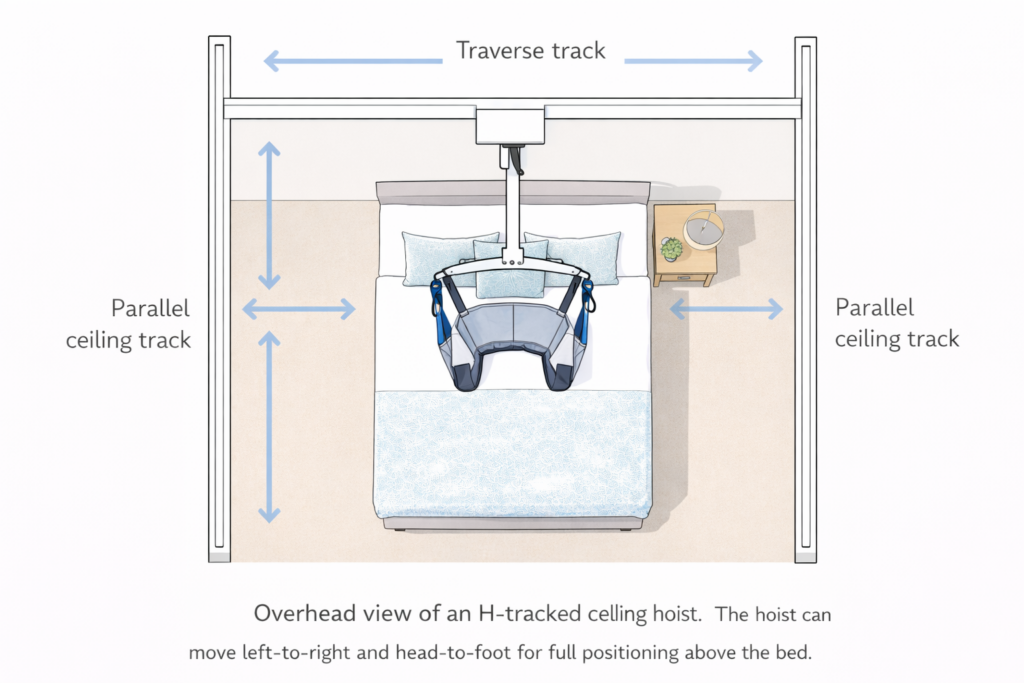
Ceiling hoists run along a fixed track installed into the ceiling structure.
They are:
- extremely smooth and stable in use
- ideal for frequent, daily transfers
- less physically demanding for carers
Many people worry about a “hospital look”, but modern ceiling tracks are usually slim and white, designed to blend into ceilings or coving. The motor unit can often be parked discreetly in a corner or cupboard when not in use.
Tracks can be installed:
- in a single room (such as a bedroom)
- between rooms (for example, bedroom to bathroom)
Ceiling hoists are often chosen for long-term or progressive needs, where consistency and ease matter most.
Standing hoists (sit-to-stand aids)
Standing hoists support people who can bear some weight through their legs but cannot stand safely on their own.
They are used to assist with:
- rising from a chair or bed
- transferring to a wheelchair or toilet
- short, supported standing movements
A simple rule of thumb helps here:
- a standing hoist assists your muscles
- a full hoist replaces the need for them during the transfer
Standing hoists are not suitable for people who cannot take weight through their legs at all, but for the right person they can encourage participation and preserve remaining strength.
What are transfer aids?
Transfer aids are simpler devices that assist movement without fully lifting the person.
They rely on some cooperation and ability from the user.
Common examples include:
- transfer boards (sliding boards between surfaces)
- turntables or swivel discs
- grab rails and support handles
- bed levers and rail systems
Transfer aids are often used when:
- the person can partially stand or pivot
- risk exists but full hoisting is not yet required
- carers need support but not full lifting assistance
They are often an important early step, before more complex equipment becomes necessary.
Who are hoists and transfer aids suitable for?
Hoists and transfer aids are often suitable for people who:
- cannot safely transfer independently
- need physical assistance during movement
- experience unpredictable weakness or fatigue
- have conditions affecting balance, coordination, or strength
- are at high risk of falls during transfers
They are also crucial for carers.
A hoist often provides the “extra pair of hands” that allows a partner or family member to continue providing care at home without risking their own physical health. In this sense, it isn’t just about the person being moved — it’s often the safety net that prevents a carer from reaching breaking point.
Used well, they support both safety and dignity.
⚠️ When hoists or transfer aids may not be appropriate
Hoists and transfer aids are not right for every situation.
They may not be appropriate if:
- the person cannot tolerate supported lifting
- transfers consistently cause distress rather than reassurance
- the home layout cannot safely accommodate equipment
- independent movement is still possible with simpler adaptations
Any transfer should feel calm and predictable. If it doesn’t, reassessment is important.
Key considerations before choosing equipment
1) What part of the transfer is difficult?
Is the main challenge:
- standing up
- sitting down
- turning
- weight-bearing
- fatigue rather than strength
Different problems point to different solutions.
2) Who is providing support?
Think about:
- whether care is provided by a partner, family member, or professional
- their physical ability and confidence
- whether support is shared or solo
Protecting the carer’s health is essential for care to continue.
3) Space and layout
Consider:
- room size and furniture
- bed height and clearance
- wheelchair access
- doorways and turning space
Mobile equipment needs more space than people often expect.
4) Frequency of use
Occasional transfers may suit simpler aids.
Daily, repeated transfers usually benefit from fixed or ceiling-mounted systems.
Advantages and disadvantages
Advantages
- Enable safe transfers when independent movement is no longer possible
- Reduce risk of falls and injuries
- Protect carers from strain and burnout
- Support consistent, dignified care
Disadvantages
- Can feel daunting at first
- Require a short period of training and practice so everyone feels confident and comfortable using the equipment
- Some systems involve installation work
- Equipment must be carefully matched to needs
💷 Typical costs in the UK (general guidance)
Costs vary depending on equipment type and installation.
As a broad guide:
- Transfer aids: from tens to a few hundred pounds
- Mobile hoists: often £800 to £2,000+
- Ceiling hoists: commonly £1,500 to £4,000+, depending on track layout
In some cases, financial support may be available through local authorities, such as via the Disabled Facilities Grant.
Organisations such as Age UK also provide independent guidance on equipment, caring, and home adaptations.
Final thoughts
Introducing a hoist into the home is often a significant milestone. It marks a shift in how care is delivered — but it is frequently a positive one, removing the fear of a fall and the physical strain of manual lifting.
When the struggle of the transfer is taken away, it often leaves more energy for the parts of the day that matter most.
This guide is intended as a starting point, helping you see hoists and transfer aids not as a loss of independence, but as tools that make it possible to stay safe, comfortable, and together at home.
If you’d like to explore related topics in more detail, you may find it helpful to visit our hoists and transfer aids guidance hub, which brings together articles on different types of equipment, planning considerations, and practical next steps.